
We all know that amniotic fluid is the most essential part of your baby’s life support system.
This helps to protect your baby and also helps in the growth of lungs, muscles, digestive system and limbs.
The fluid will develop immediately after the formation of amniotic sac i.e. about 12 days after conception.
If the level of amniotic fluid becomes too much, then the condition is called as polyhydramnios.
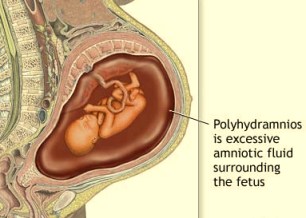 Your practitioner can measure the level of amniotic fluid by using the method called as amniotic fluid index (AFI) evaluation or deep pocket measurements.
The diagnosis for polyhydramnios is performed when the AFI proves the fluid level greater than 25 centimeters, more than 2000mL, or deep pocket measurement less than 8. There is 1-2% chance for a pregnant woman to have excess amniotic fluid.
Cause behind polyhydramnios:
Various causes lead to elevated levels of amniotic fluid such as:
Congenital defects: Excess fluid levels increase the chance of congenital defects. The birth defects obstruct the swallowing of the amniotic fluid, which can forbid ingestion of the fluid, thus resulting in excess levels. Some other birth defects like neurological abnormalities or intestinal tract blockages can lead to polyhydramnios.
Twin to twin transfusion syndrome: Usually, this problem affects similar twin pregnancies. This problem occurs when one baby receives excess blood and the other too little because of the connections between the blood vessels in the shared placenta.
Diabetes during pregnancy: Studies showed that there is some link between diabetes and excess amniotic fluid.
Including the above conditions, there are 65% of the cases who have polyhydramnios due to some unknown reasons.
Risks to you and your developing baby due to polyhydramnios:
Most of the cases of polyhydramnios are mild and they lead to few complications. Higher levels of amniotic fluid can lead to experience the following conditions:
- Placental abruption
- Cesarean delivery
- Intrauterine growth restriction that leads to skeletal malformations
- Postpartum hemorrhage
- Preterm labor and delivery
- Stillbirths occurring in 4 out of 1000 pregnancies who are suffering from polyhydramnios verses about 2 out of 1000 pregnancies who have normal fluid levels.
- Premature rupture of the membranes (PROM)
Treating polyhydramnios:
Most of the cases of polyhydramnios can be easily treated and they do not lead to any serious issues if the pregnancy is observed closely. You need to undergo regular sonograms to measure your baby’s growth, fetal assessment and biophysical profile. Some other treatments for polyhydramnios include:
Amnioreduction: This is the method used to remove the excess fluid. This is performed with the help of amniocentesis. This procedure has some risks and also there is a chance to rebuild the fluid after reduction.
Medications: Usage of medications reduces the fluid level and is 90% effective. But, don’t use medications when you are 32 weeks pregnant and above due to some complications.
Delivery of the baby is also considered as an option.






I have 23 week pregnancy now.When i go for Ultrasound check up we find that the amount of aminotic fluid is 33cm.I check the Sugar test before but not find any traces.what i want to do for that.Please reply…
Dear,
i am in 23 weeks of pregnancy. and have too much amniotic fluid. but no one can guess the cause of this. doctors advise me to take complete bed rest and to take iron and loprin regularly.
Dear I am 33 weeks and 5 eays. My amniotic fluid has been on the rise since week 28. It is now at 30cm. Since you are only at 23 weeks, ask your doctor if there is any medications that you can take to help reduce your fluid. Also, amniocentesis, or “amnioreduction” may be an option for you. However, know that this procedure holds its own risks you should consult with your OB about. I hope this helps. P.S. Stay off your feet as much as possible, and good luck.
I am trulу pleasеd to glanсe at this website pοsts which contains plenty of valuablе informatiоn,
thanks foг proviԁing such statіstics.