Archive for the 'POSTPARTUM' Category
C-section can be emotionally and physically challenging for every woman. At times, C-section is safer for mothers and babies than normal delivery.
However, complete recovery from a C-section requires seeking out practical help from others.
After C-section, most women stay with their babies in hospital for almost three days, and will feel the pain after the anesthesia wears off.
To provide relief from the pain, your doctor may prescribe intravenous pain medications.
Soon after C-section, you will be encouraged to walk and move around. This can help you to speed up your recovery and it also helps to prevent dangerous blood clots in your body and constipation.
After you leave home, you should take self-care measures suggested by your doctor.
Here are a few of commonly suggested self-care measures to be followed at home after C-section.
- Give yourself enough time to take rest and don’t try to lift any objects heavier than your body until your six-week check-up.
- Drink more fluids to replace those lost during your delivery and breast-feeding. Don’t forget to empty your bladder frequently and reduce the risk of urinary tract infections.
- Avoid sexual intercourse, but don’t ignore intimacy with your partner.
A new study examines the relationship between breastfeeding and postpartum weight retention.
The study, which looked at data for more than 25,000 women participating in the Danish National Birth Cohort, measured how long women breastfed and also how intensely.
Each woman received a breastfeeding score. Results showed that women with higher breastfeeding scores were more likely to lose their pregnancy weight six months after giving birth.
Researchers concluded that women who gain a reasonable amount during pregnancy and breastfeed exclusively are likely to lose all pregnancy weight six months after giving birth.
They also estimate that women who breastfeed retain 2 kilograms (4.4 pounds) less than women who don’t breastfeed at six months after giving birth.
Participants, all recruited by their doctors during their first prenatal visit, were interviewed four times — twice during pregnancy, as well as six months after giving birth and 18 months after giving birth.
They answered questions about their weight and how they were feeding their babies.
Read more at WebMD
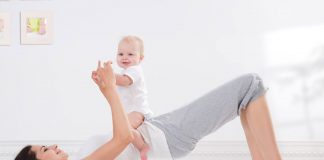
Want to attain lean body that you had before your pregnancy?
For this you need to follow postpartum fitness program.
Before starting the program, you need to get proper understanding of your body.
Giving birth to a baby means a lot of things like: losing sleep, learning to manage your tiny little one, and dealing with the weight that you gained during your pregnancy.
Every pregnant woman can gain an average of 30 pounds during pregnancy period, but most of you can gain even more. Usually, you will lose 18-20 pounds within a month after the delivery.
Being active during this period is even more important because it increases your metabolism, removes those extra pounds, offers you much needed energy and also helps to reduce the stress and tension.
But, you will get a doubt that how much and when to start the postpartum exercise routine. You knew that including exercise routine back into your daily lifestyle is a gradual process.
How much and when to start postpartum exercise routine?
Pregnancy is the period that you encounter a large number of changes in your body. So, it takes time to get back. If you exercised throughout the pregnancy and had normal vaginal delivery, then you can safely practice the postpartum workouts, like walking, stretching and modified push-ups, within few days after giving birth [Pregnancy exercises].
Pregnancy changes your entire body, including your hair also.
Hair loss after pregnancy is really normal, similar to the hair loss during pregnancy. This is a major concern for many women.
Similar to various changes developed during pregnancy, hair loss is also a temporary problem that you will face.
Normal hair loss for every woman is 100-125 hairs per day, but after delivery this will be increased to 500 a day.
40-50% of pregnant women face hair loss after pregnancy. This process continues for three months after your delivery.
Why hair loss after pregnancy happen to many women?
The main reason behind hair loss after pregnancy is, during your pregnancy the increased levels of hormones keeps your hair away from falling, but once after your delivery, the hormones return into their original levels, thus allowing hair fall to return to the normal cycle.
During pregnancy, your body produces increased levels of estrogen in order to support the health and growth of yours and your baby. High levels of estrogen can lead to hair growth. Also, estrogen boosts your metabolism thus allowing the nutrients to spread every where in your body, including your hair also.
Nobody wants to develop stretch marks on their body, but pregnancy stretch marks are common along with backaches, nausea, frequent urination and fatigue.
75-90 percent of all pregnant women will develop stretch marks in their pregnancy.
Red lines will be appeared during your 6th or 7th month of pregnancy.
Pregnancy stretch marks not only appears on your belly, but also on the other areas that get larger such as upper thighs, breasts, buttocks and also on your arms, depending on how much weight you gain and your genetic history.
Tips to prevent pregnancy stretch marks:
- Consume a healthy diet in order to nurture your skin. Consume the necessary prenatal vitamins. Take foods in right quantities of calories and also consume the foods high in protein, calcium, whole grains, fruits and vegetables high in vitamins.
- Drink plenty of water and also consume fluids frequently as they can keep your body hydrated and preserve elasticity.
- Follow strategies for steady weight gain. For a healthy pregnant woman, weight gain should be in between 25-35 pounds, little more for underweight women or having twins. [Healthy Pregnancy Weight Gain]
After pregnancy, most of the new moms feel happy for a moment and then from the next moment they feel sad.
There are two conditions; they are baby blues and postpartum depression; from which you may suffer after giving birth to your baby.
Baby Blues is the condition; in which you feel moody and sad for a week.
Postpartum depression is the condition which continues for more than two weeks.
Postpartum depression after pregnancy makes you feel anxious, restless, worthless and fatigued.
Most of the new moms will hurt themselves or their babies. Postpartum depression does not go away quickly. In the very rare conditions, new moms will suffer from something more serious.
Sometimes they may not eat, feel trouble while sleeping and finally after the pregnancy this can lead to postpartum depression.
Warning signs of postpartum depression:
These warning signs indicate you that you are in postpartum period, so call your health care provider if you have any of these symptoms:
- Crying that lasts for several days
- Fever greater than 101 F
- Feelings of helplessness, hopelessness, worthless and over guilty
- Feeling irritable, restless and anxious
Recent Posts
- Carrier Screen Test For Cystic Fibrosis
- Pre-Pregnancy Exercise May Not Prevent Back Pain
- Pregnancy Week 38 - Only Two Weeks Of Pregnancy To Go
- Fetal Heart Monitor - A Device Used To Hear Your Baby's Heartbeat
- How To Avoid Tension Headaches During Pregnancy?
- Chorionic Villus Sampling May Increase Risk Of Hemangiomas
- Pregnancy Week 37 - Beginning Of Full-Term Pregnancy
- 3 Most Common Birth Control Myths
- A Low Dose Of Caffeine When Pregnant May Damage The Heart Of Offspring For A Lifetime
- Vitamin D Deficit In Pregnancy Tied To Cesarean Risk